

- What's the biggest difference between inpatient rehab, outpatient treatment, and sober living?
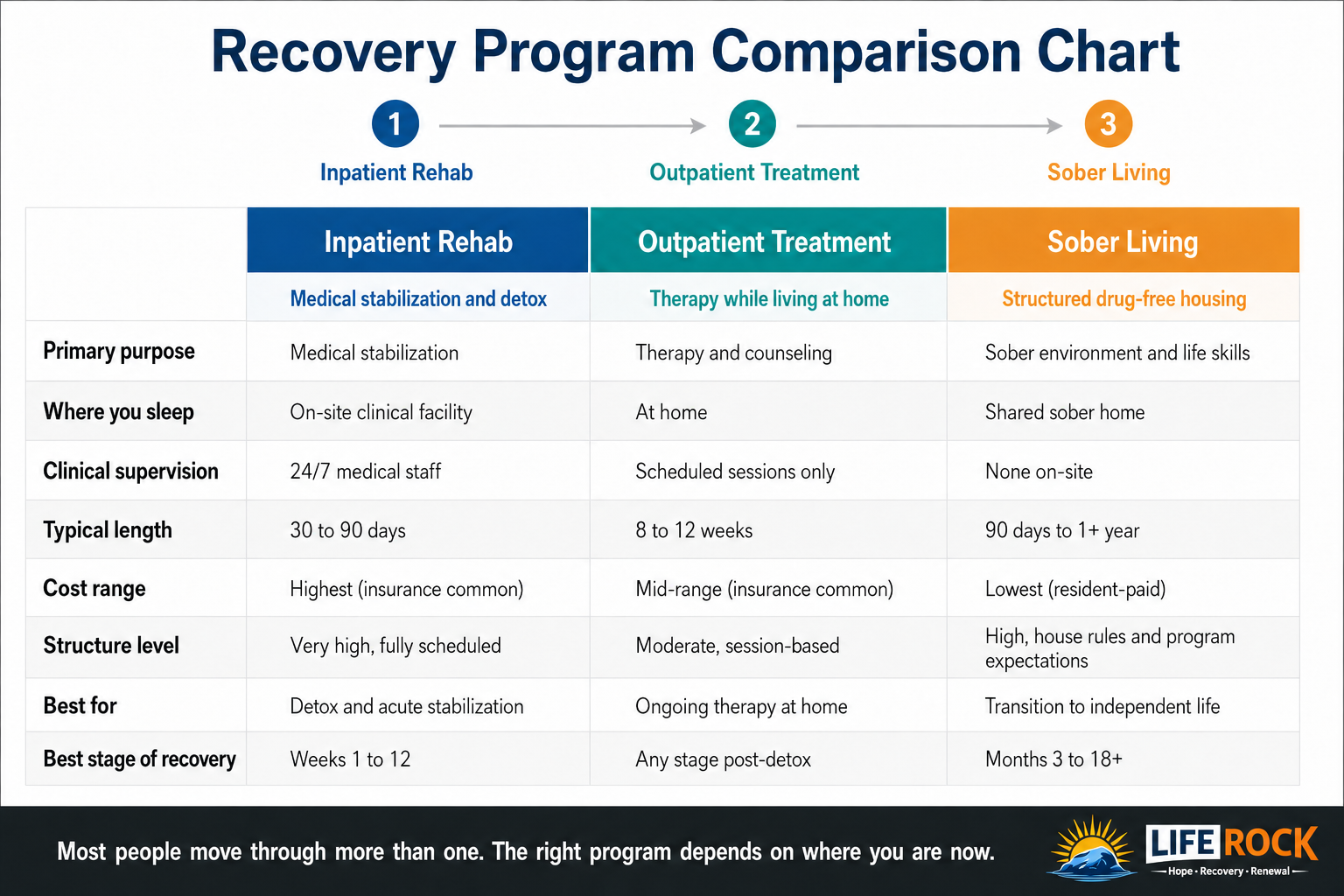
Inpatient gives you medical care and 24/7 supervision during the early stabilization period. Outpatient gives you therapy while you live at home. Sober living gives you a drug-free house and community for the months it takes to rebuild a normal life. Different stages, different jobs.
- Do I have to do inpatient before sober living?
No. Some people come to sober living directly from home if they’ve already stopped using and have at least 72 hours clean. Life-Rock’s minimum is 72 hours sober plus a genuine desire to recover. Many residents come from inpatient, but not all.
- How long will I need to stay in each program?
Inpatient typically runs 30 to 90 days. Outpatient runs 8 to 12 weeks, sometimes longer. Sober living at Life-Rock has a 90-day minimum for men and 180 days for women, and most residents stay a year or more because that’s how long real change tends to take.
- What happens if I pick the wrong program first?
It’s recoverable. Someone who starts outpatient and finds they can’t stay sober at home can move into sober living. Someone who leaves inpatient early can come back. The bigger risk is skipping sober living entirely and relapsing during the transition back to independent life.

You’ve decided to get help, or someone you love has. Now comes the second hard question: what kind of program?
The words get thrown around interchangeably. Rehab. Detox. Outpatient. Sober living. Transitional housing. For someone in crisis, or a parent trying to help a son at 2 a.m., the differences blur fast.
Recovery programs for addiction in Sonoma County generally fall into three buckets, and each one is built for a different stage of the process. Most people move through more than one. Choosing well means matching the program to where you actually are right now, not where you hope to be in six months.
Key Takeaways
- Inpatient rehab, outpatient treatment, and sober living solve different problems at different stages of recovery. They aren’t competitors.
- The right first step depends on how recently you used, whether you need medical detox, and how stable your home environment is.
- Most people who stay sober long-term move through two or three of these programs, not just one.
- Sober living is the bridge between clinical treatment and independent life. Skipping it is where a lot of relapses happen.
- Structure and community matter at every stage. The program that gives you the most of both, for the stage you’re in, is usually the right one.
Understanding Inpatient Rehab
Inpatient rehab is a live-in clinical program where you stay on-site 24/7, usually for 30 to 90 days. It combines medical detox, therapy, medication management, and structured daily programming.
People choose inpatient when they need to physically stop using and can’t do it safely at home. It’s the right call when withdrawal has medical risks, when the home environment is full of triggers, or when someone has tried outpatient and it hasn’t held.
Core features:
- 24/7 medical and clinical supervision
- Detox with medication support when needed
- Individual and group therapy on a set daily schedule
- No access to substances, phones and visitors limited
- Typical stay: 30, 60, or 90 days
Inpatient rehab is often the first stop for someone coming off heavy or long-term use.
Understanding Outpatient Treatment
Outpatient treatment gives you the therapy and clinical support of rehab without the live-in piece. You attend sessions during the day or evening and go home afterward.
People choose outpatient when they’ve already detoxed, when their home life is stable enough to support recovery, or when they need to keep working or caring for family. It’s also common as a step-down from inpatient.
Core features:
- Scheduled therapy sessions, usually 3 to 5 days a week
- Intensive outpatient programs (IOP) run 9 to 15 hours per week
- Group therapy, individual counseling, sometimes medication-assisted treatment
- You live at home, so recovery has to hold up against real-world triggers
- Typical length: 8 to 12 weeks, sometimes longer
Outpatient treatment works well when the person has a safe place to sleep and a support network at home. When they don’t, sober living fills that gap.
Understanding Sober Living
Sober living is structured, drug-free transitional housing where you live with other people in recovery, follow house rules, work or look for work, and stay accountable to a shared program. It’s not clinical treatment. It’s the environment that makes clinical treatment stick.
People often choose sober living after inpatient rehab, alongside outpatient treatment, or when their home environment isn’t safe for recovery. It’s for someone past the medical piece of detox who now needs to relearn how to live sober.
Core features:
- Drug-free house with zero-tolerance policy and random testing
- Required 12-step meetings (90 in 90 days at Life-Rock, then 5 per week)
- Twice-weekly house meetings and daily chores
- Curfews, house responsibilities, work program
- Live-in house managers, most in recovery themselves
- Typical stay: 90 days minimum for men, 180 for women at Life-Rock, often a year or more
The most important takeaway: these are three different jobs. Inpatient handles the body, outpatient handles the mind, and sober living handles daily life.
A Mismatched Program Can Set Back Recovery
Picking the wrong program at the wrong stage is one of the most common reasons early recovery falls apart.
- Someone who needs medical detox but tries outpatient can end up in the ER, or worse.
- Someone who finishes 30 days of inpatient and goes straight home to the same roommates and routines that fed the addiction often relapses within weeks.
- A person doing outpatient while sleeping on a couch in a chaotic house is fighting the program every night.
Cost matters too. Inpatient runs $15,000 to $40,000 for 30 days before insurance. Outpatient costs less but requires a stable home. Sober living is the most affordable per month and lasts long enough to change the habits behind relapse.
The choice also affects what happens after. A recovery path that includes sober living has a much better chance of holding a year out, because it gives the person time to build a sober routine, sober friends, and a sober identity before returning to full independence.
Picking the Right Program for Your Stage of Recovery
Choose Inpatient Rehab If:
- You’ve been using heavily or daily and haven’t stopped yet
- Withdrawal from your substance carries medical risk (alcohol, benzos, opioids especially)
- You’ve tried to quit at home and haven’t been able to
- Your home has active substance use or serious triggers
- You need to physically remove yourself from your current situation
Choose Outpatient Treatment If:
- You’ve already detoxed, either at inpatient or on your own with medical clearance
- You have a stable, sober place to live
- You need therapy, group support, or medication-assisted treatment
- You need to keep working, caring for kids, or handling court-mandated obligations
- You’re stepping down from inpatient and need continued clinical support
Choose Sober Living If:
- You’ve completed inpatient or are stable enough to skip it
- Your home environment isn’t safe for recovery, or you don’t have one
- You want structure, accountability, and community while you rebuild
- You’re doing outpatient and need a sober place to sleep at night
- You’re 90 days out from detox and know you’re not ready to go it alone
Most people don’t pick just one. A typical path looks like: 30 days inpatient, then outpatient plus sober living together for the next few months, then sober living for the rest of the year.
Don’t Underestimate Sober Living
Inpatient and outpatient get most of the attention because they’re clinical. Sober living gets talked about less, and it’s the piece that most often decides whether the first two hold.
Rehab programs in Sonoma and Napa counties routinely refer people to sober living homes at discharge. They know the weeks after rehab are when a safe environment matters most.
What makes Life-Rock’s approach distinct:
- Nonprofit, so admissions are selective. Life-Rock looks for a true desire to recover, not just a bed to fill.
- Five homes across Santa Rosa, Petaluma, and Windsor.
- Live-in house managers, most in recovery themselves.
- Long minimum stays (90 days for men, 180 for women), because sustained change takes sustained time.
- 12-step aligned, non-denominational. No religious requirements. Everyone committed to their recovery and the recovery of others in the house is welcome.
- Confidentiality treated as a spiritual principle.
Sober living covers the longest stretch of recovery and the hardest part: learning to live without substances in the real world. For anyone comparing recovery programs for addiction in Sonoma County, it’s worth a close look.
Not Sure Which Program is Right for You? Give Us a Call
Life-Rock is a Sonoma County nonprofit running structured sober living homes for men and women in recovery. Whether you’re finishing rehab, doing outpatient, or trying to figure out where to start, a short conversation can help you sort out what fits your situation.
Contact us online or call Life Rock at (707) 293-60009 to learn more about our program.