

- Is sober living the same as rehab?
No. Rehab provides clinical treatment, therapy, and sometimes detox. Sober living homes are drug-free residences with structure, peer community, and accountability. Life-Rock is a sober living organization, not a rehab, and it works with treatment centers as a next step.
- How long does someone stay in sober living?
At Life-Rock, the minimum is 90 days for men and 180 days for women. Most residents stay longer, often a year or more. Length depends on personal history, progress, and what the resident needs to feel steady.
- What can families do while their loved one is in a sober living home?
Attend family support groups such as Al-Anon or Nar-Anon, keep boundaries clear, stay in contact within the home’s rules, and take care of your own health. Recovery is easier when the family around it is also getting support.

When a family member is struggling with substance use, the questions pile up fast. What kind of help actually works? What happens after rehab? Are you supposed to be doing something differently at home?
Most families walking into this have never navigated recovery before, and the information out there can feel scattered, clinical, or contradictory. Understanding the shape of the process, including what recovery programs for addiction in Sonoma County involve, gives you a clearer path to helping without burning out or guessing.
This guide covers what recovery is, why it works best as a continuum of care, where families fit in, and why structured sober living often makes the difference between short-term abstinence and long-term change.
Key Takeaways
- Addiction affects the whole household, not only the person using substances.
- Recovery works best as a continuum: detox, treatment, sober living, and long-term community support.
- Structured sober living homes fill the gap between rehab and independent life.
- Families support recovery through steady presence, clear boundaries, and their own healing.
- Community environments strengthen sobriety through routine, peer support, and shared responsibility.
- Life-Rock operates nonprofit sober living homes for men and women across Sonoma County.
Understanding Addiction Recovery
Recovery is the ongoing process of rebuilding a life after substance use disorder. It includes physical stabilization, mental and emotional healing, behavioral change, and repairing daily structure and relationships.
Clinicians describe substance use disorder as a chronic condition. That framing matters because it explains why one round of treatment usually is not the whole story.
Recovery involves managing triggers, building new habits, and staying connected to people who understand what is happening.
Addiction Affects the Whole Family
Addiction changes how a household runs. Sleep, trust, finances, and daily routines all take a hit. Children feel it. Partners absorb stress they rarely voice. Siblings either pull back or step into roles they shouldn’t have to carry.
Family healing is part of a healthy recovery. Support for families often includes:
- Support group meetings
- Family therapy
- Education about substance use disorder
- Honest conversations about what has been going on at home
When the family heals alongside the person in recovery, the whole system becomes steadier. Boundaries hold. Communication improves. The person in recovery has something real to come back to.
Recovery Works Best as a Continuous Process
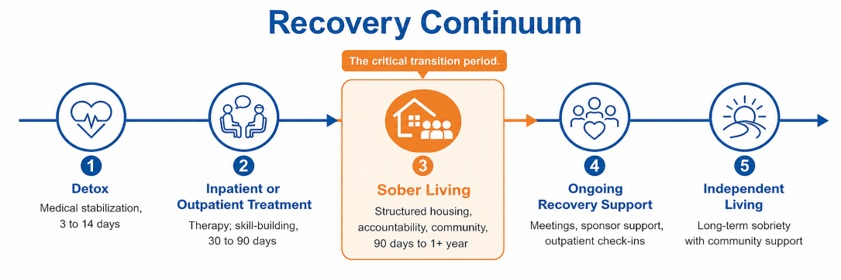
A single stay in rehab is rarely enough on its own. Detox handles the physical piece. Inpatient or outpatient treatment addresses underlying issues, trauma, and coping skills.
The weeks and months after treatment are the highest-risk period for relapse. New routines, work, meetings, and relationships are all being built at once. Returning directly to an old environment puts too much pressure on habits that haven’t had time to hold.
A continuum of care links each step together. It usually looks like this:
- Detox, medically supervised when needed.
- Inpatient or outpatient treatment, focused on therapy and stabilization.
- Structured sober living, providing a drug-free home, accountability, and community.
- Ongoing recovery support, including 12-step meetings, sponsorship, service, and eventually independent living.
Each step handles a different piece. Skip one, and the next one gets harder.
How Families Support Recovery
Family involvement is one of the strongest predictors of long-term recovery outcomes. The way a family responds shapes the environment around the person in recovery.
Practical ways families support recovery:
- Learn about substance use disorder as a health condition, not a character flaw.
- Set clear boundaries around behavior, money, and living arrangements.
- Encourage the recovery plan without micromanaging it.
- Attend family programs offered by treatment providers or sober living homes.
- Take care of your own well-being through therapy, support groups, and rest.
- Notice small progress, and stay steady when there are setbacks.
Boundaries often feel harsh at first. In practice, clear expectations give the person in recovery a solid foundation to work with. Vagueness tends to make things worse.
Structured Community Environments Strengthen Sobriety
A sober living home is a drug-free residence where adults in recovery live together under shared rules and daily structure. It sits between clinical treatment and fully independent life.
At a well-run home, residents typically:
- Attend 12-step meetings on a regular schedule.
- Follow curfews and complete daily chores.
- Hold jobs or actively look for work.
- Meet with the house manager and housemates for check-ins.
- Submit to random drug and alcohol testing.
- Contribute to the recovery of everyone else in the house.
That structure removes the pressure of finding stable housing during a vulnerable window, places the resident inside a community of people doing the same work, and adds accountability from people who notice when something is off.
For families, it takes pressure off the household. The person in recovery has a safe place to live and peers who understand what they are going through. Family relationships get room to repair.
What the First Year of Recovery Typically Looks Like
The year following treatment is when the real work of recovery begins. It is also where most setbacks happen. Understanding the shape of that year helps families support their loved one without guessing.
Months 1 to 3: Stabilization
The brain and body are still adjusting. Sleep is often disrupted. Cravings can come in waves. Emotions run high because substances are no longer numbing them. This is when structure matters most:
- Daily routine
- Meetings
- Work or job search
- A drug-free place to live
National Institute on Drug Abuse data points to these first 90 days as the highest-risk window for relapse.
Months 4 to 6: Habit building
New routines start to hold. The person in recovery is usually working, attending 5 or more meetings a week, meeting with a sponsor, and taking on responsibilities in the household.
Old friendships and environments start to feel less pulling. Family relationships often begin to repair, though slowly.
Months 7 to 12: Identity work
Deeper questions about identity, relationships, and purpose tend to surface during this period as the initial focus on sobriety gives way to rebuilding a life. What does life look like sober? What kind of work? What kind of relationships?
Underlying issues such as trauma, grief, or untreated mental health conditions often surface here. Sober living gives residents a place to work through this without carrying the added pressure of rent, isolation, or an unstable home environment.
Signs a Sober Living Environment is the Best Next Step
Structured sober living may be the right next step .if any of the following apply to your loved one’s situation.
- Your loved one has completed detox or a treatment program and needs a safe place to land.
- Their previous living situation includes substances, unstable relationships, or triggers.
- They want structure and are not ready for fully independent living.
- Family members are exhausted from being the only source of accountability.
- They have relapsed after previous attempts at recovery without transitional housing.
- They are 18 or older and have at least 72 hours of sobriety.
If several of these apply, it is worth talking about sober living as the next step.
How Life-Rock Supports Recovery and Families
Life-Rock is a nonprofit that operates structured sober living homes throughout Sonoma County. The homes serve men and women recovering from alcohol, methamphetamine, opioid, benzodiazepine, and other substance use.
What sets Life-Rock apart from other sober living programs:
- Nonprofit model. Resources go to residents. Admissions stay selective.
- Lived-experience staff. Most house managers are in recovery themselves.
- Real structure. Zero-tolerance policy, drug testing, curfews, twice-weekly house meetings, work requirements, and 12-step involvement.
- Long minimum stays. 90 days for men, 180 days for women. Most residents stay longer.
- Gender-specific homes. Five houses across Sonoma County.
- Anonymity is treated as a spiritual principle. Stays remain private.
Life-Rock is a top referral source for treatment centers across Sonoma and Napa counties, which makes it a natural next step after inpatient or outpatient care.
Talk to Life-Rock About Sober Living After Rehab
Families researching recovery programs for addiction in Sonoma County often find the biggest gap sits between the end of treatment and life at home. Structured sober living fills that gap. Life-Rock supports families through what sober living looks like, how admissions work, and whether one of the homes is the right setting for your loved one.
Contact us online or call Life-Rock at (707) 293-6009 to learn more about available homes and the admissions process.