

- How Does Transitional Sober Living Work?
Transitional sober living works by giving people in recovery a structured, substance-free home to live in while they practice sober life skills. Residents:
- Follow house rules
- Attend recovery meetings
- Often work or look for work
- Support each other through shared accountability
It’s a middle step between treatment and fully independent living.
- How Long Do You Stay in Transitional Sober Living?
Most people stay in transitional sober living for 6 to 12 months, though every situation is different. Some stay longer when it supports their recovery.
Length of stay should be based on where you are in your recovery, not an arbitrary date on a calendar. At Life-Rock, we encourage people to stay as long as they’re growing and committed to the program.
- Who Pays for Transitional Sober Living?
In most cases, the resident pays for their own transitional sober living, often with help from family or by working during their stay. Some homes accept insurance, grants, or sliding-scale fees for those who qualify.
Because Life-Rock is a nonprofit, we work to keep our homes accessible. Call us to talk through what’s possible for your situation.

There are a lot of steps on the path to addiction recovery. From the very first time you admit to your addiction, to making your way through a treatment center. But the jump back into a “normal” life once sober can feel monumental, which is why transitional sober living houses are here to help bridge that gap.
Thinking about making the move into transitional living programs in Sonoma County? Whether you’re feeling excited, nervous, overwhelmed, or a bit of all of the above, you’re not alone. At Life-Rock, we’ve walked this road with many people before you.
Key Takeaways
- Transitional sober living is the structured, supportive space between treatment and fully independent sober life.
- Preparing emotionally matters just as much as packing the right stuff.
- Structure in a sober living home isn’t about restriction. It’s the foundation that gives recovery room to grow.
- Pack light, pack recovery-focused, and leave distractions behind.
- Expect hard days. Expect progress. Both are part of the deal.
- Life-Rock serves people in recovery across Marin and Sonoma Counties with homes rooted in commitment, community, and hope.
What Is Transitional Sober Living?
Transitional sober living is the in-between space. You’re not in a treatment center anymore, but you’re also not fully on your own.
A good transitional sober living home gives you a safe place to practice everything you learned in treatment, while you’re still surrounded by people who are going through similar sober journeys.
What Transitional Sober Living Environments Offer
- A structured environment where people in recovery live together
- Clear house rules, daily routines, and accountability
- Access to local recovery meetings and the broader sober community
- A stepping stone into the next phase of your sober life
- Peer support from housemates walking the same path
In Sonoma County, that often means living in a peaceful, scenic area with easy access to meetings, recovery fellowship, and plenty of nature to help you reset. At Life-Rock, it also means living in a house that’s all about commitment to yourself, and to your housemates in recovery.
How to Get Ready for Transitional Sober Living
Here are some practical steps you can take to prepare yourself for this next chapter.
Get Honest with Yourself
Before you move in, take a quiet moment and check in:
- Are you ready to live with others who are also in recovery?
- Can you handle being held accountable, even on hard days?
- Are you open to structure and daily routines?
This isn’t about being perfect. It’s about being honest and willing. Those two things carry more weight in sober living than anything you can put in a suitcase.
Understand That Structure Equals Support
Some people hear “rules” and think “restrictions.” But in sober living, structure actually helps. It gives your days rhythm and purpose when early recovery can feel formless.
Here’s what structure typically looks like:
- Morning routines and shared household responsibilities
- Chore rotations
- Curfews
- Mandatory meeting attendance (at Life-Rock, we ask for 90 meetings in 90 days, then 5 per week after that)
That may sound like a lot. But structure is often what gives early recovery the stability to actually hold.
Ask Questions Before You Move In
Don’t just show up and wing it. Reach out to the house manager or contact person ahead of time and ask:
- What does a typical day look like?
- What are the house rules?
- Is there a curfew?
- What’s expected of me as a resident?
- How are meetings and chores handled?
The right transitional sober living home will welcome your questions. If they don’t, that tells you something too.
What to Pack for Transitional Sober Living
You don’t need to bring your whole life with you. Keep it simple.
What to Bring
- Comfortable clothes for meetings, work, and downtime
- Basic toiletries (nothing with alcohol in it)
- Any prescriptions, clearly labeled in their original bottles
- Recovery tools: journal, Big Book or recovery readings, sponsor and support contact list
- Work or job search materials if you’re planning to work during your stay
- A good attitude (seriously, it helps more than you’d think)
What to Leave Behind
- Drama and unresolved outside conflict
- Distractions that pulled you away from recovery (gaming consoles, certain electronics, “going out” clothes)
- Any substance, over-the-counter product, or mouthwash that contains alcohol
- Anything that reminds you of past use
The rule of thumb ⭐: if it supports your recovery, bring it. If it competes with your recovery, leave it.
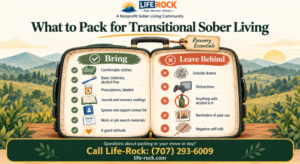
What to pack for transitional sober living
Setting Realistic Expectations for Life in Recovery Housing
Don’t go into sober living thinking everything will magically get easier the moment you walk through the door. It won’t. But it will get more manageable, especially with the right mindset.
Keep these truths in mind:
- There will be tough days. That’s not a sign something is wrong. It’s a sign recovery is real.
- Not everyone you live with will be your best friend. But everyone in the house is working toward something similar.
- You’ll be asked to show up, even when you don’t feel like it. That showing up is where the growth happens.
- Progress beats perfection. Always.
Why Life-Rock Is a Trusted Choice for Transitional Living Programs in Sonoma County
If you’re looking at transitional living programs in Sonoma County, choosing where you land matters. The home, the people, and the structure all shape how your early sober life takes root.
Life-Rock is a nonprofit organization serving people in recovery across Marin and Sonoma Counties. We’re not a treatment center. We’re the next step after one.
Here’s what makes Life-Rock different:
- Nonprofit mission. Our focus is on your recovery, not profit margins.
- Structure built on experience. Our homes are run largely by people who’ve walked this road themselves.
- Community that holds you. Housemates aren’t roommates. They’re part of your recovery network.
- Accountability with compassion. We expect commitment, and we meet it with care.
- Faith-friendly, not faith-required. People of all backgrounds and beliefs are welcome.
- A real way out and a way up. We’re here for the long haul of your recovery, not just the first few weeks.
If you’re committed to your recovery and open to walking it with others who feel the same, we’d love to hear from you.
You’re Not Alone. Call Life-Rock Today.
You might feel nervous about this next chapter. That’s completely normal. Every person who’s walked through our doors felt something similar on the first day.
At Life-Rock, we don’t expect perfection. We ask for commitment. If you’re looking at transitional living programs in Sonoma County or Marin County, know this: you’ve already taken a major step just by learning what’s next. We’d be glad to walk the rest of this journey with you.
Call today or contact us online to learn more or schedule a visit.
Men’s Help: (707) 293-6009
Women’s Help: (707) 293-6009